

Oversupply in certain submarkets, elevated vacancy levels, and regulatory bottlenecks continue to temper the sector’s recovery. Colliers Philippines believes that accelerating housing approvals, strengthening public-private partnerships, and expanding residential development beyond Metro Manila will be critical to sustaining growth over the medium term.
Demand remains strongest in the economic and affordable housing segments. In the first half of 2026, these categories, particularly projects priced between PHP1.8 million and PHP3.6 million, accounted for a growing share of condominium take-up. Government initiatives such as the Pambansang Pabahay para sa Pilipino (4PH) Program and Pag-IBIG Fund’s reduced mortgage rates should further stimulate demand by making homeownership more accessible to a broader segment of Filipino buyers. Meanwhile, supply remains muted in Metro Manila due to a still-sizable number of unsold units, especially in the Bay Area and fringes of Makati.
Colliers Philippines believes that a coordinated approach involving government agencies, financial institutions, and private developers remains essential to achieving a more balanced, inclusive, and sustainable housing market within and outside Metro Manila.
Address supply issues in high-growth areas
Colliers encourages developers to continue expanding their residential footprint in high-growth provincial markets where end-user demand remains resilient. Colliers data showed that average take-up of house-and-lot (H&L) projects in key localities such as Cavite, Laguna, Batangas, Pampanga, Bulacan, Cebu, Negros Occidental, Iloilo, Davao, and Cagayan de Oro ranged from 88 percent to 96 percent as of Q1 2026, indicating sustained demand for horizontal developments. Meanwhile, condominium projects in these markets also posted healthy take-ups between 82 percent and 91 percent.
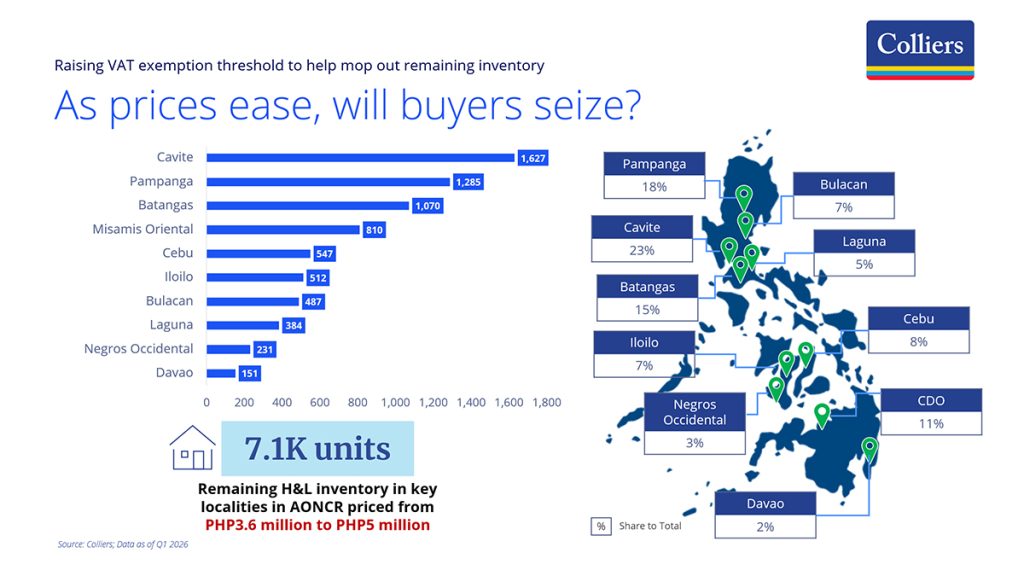
H&L and condominium market in AONCR (Q1 2026)
Government reforms should further strengthen this provincial expansion. We are optimistic that the decentralization of license-to-sell (LTS) approvals by the Department of Human Settlements and Urban Development (DHSUD) will accelerate project launches outside Metro Manila beyond 2026. Under the new memorandum, DHSUD regional offices will now have the authority to process, evaluate, and approve regulatory LTS applications–an initiative to address the low LTS issuances recorded in H1 2026.
Stronger public-private partnership
Colliers previously cited the 4PH Program as a key contributor to the increasing activity in the affordable housing segment. By prioritizing government intervention to stimulate the economy, the housing initiative is driving momentum in the condominium market, with Colliers recording an improvement in take-up for economic to affordable projects (PHP1.8 million to PHP3.6 million).
Meanwhile, the Pag-IBIG Fund is currently offering promotional interest rates as low as 4.5 percent per year for qualified borrowers buying homes above the socialized housing ceiling of PHP1.8 million until end-2026. Pag-IBIG also raised its loan ceiling to PHP10 million from PHP6 million.
Another viable option is to raise the Value Added Tax (VAT) exemption threshold for residential properties from the current PHP3.6 million. For instance, Colliers Philippines data revealed that there were about 9,300 units of unsold ready-for-occupancy (RFO) condominium inventory in Metro Manila priced from PHP3.601 million to PHP5 million as of Q2 2026. In our opinion, raising the VAT exemption ceiling could help reduce remaining inventory and improve affordability by shielding buyers from elevated interest and mortgage rates.
We believe that a strong public-private partnership should play a crucial role in addressing the supply-demand gap in the residential sector.
The Philippine residential market’s long-term growth will depend on how effectively stakeholders address both affordability and supply challenges. While demand remains robust, particularly in the economic and affordable housing segments, sustained recovery requires faster housing approvals, stronger public-private collaboration, and greater investment in high-growth provincial markets. Government initiatives such as the 4PH Program, Pag-IBIG financing support, and regulatory reforms are helping improve accessibility and stimulate demand. However, unlocking the sector’s full potential will require coordinated action among government agencies, developers, and financial institutions to expand housing opportunities, reduce inventory imbalances, and create a more inclusive, sustainable, and geographically diversified residential market across the Philippines.
#PhilSTARPropertyFeature
#FeaturedStory