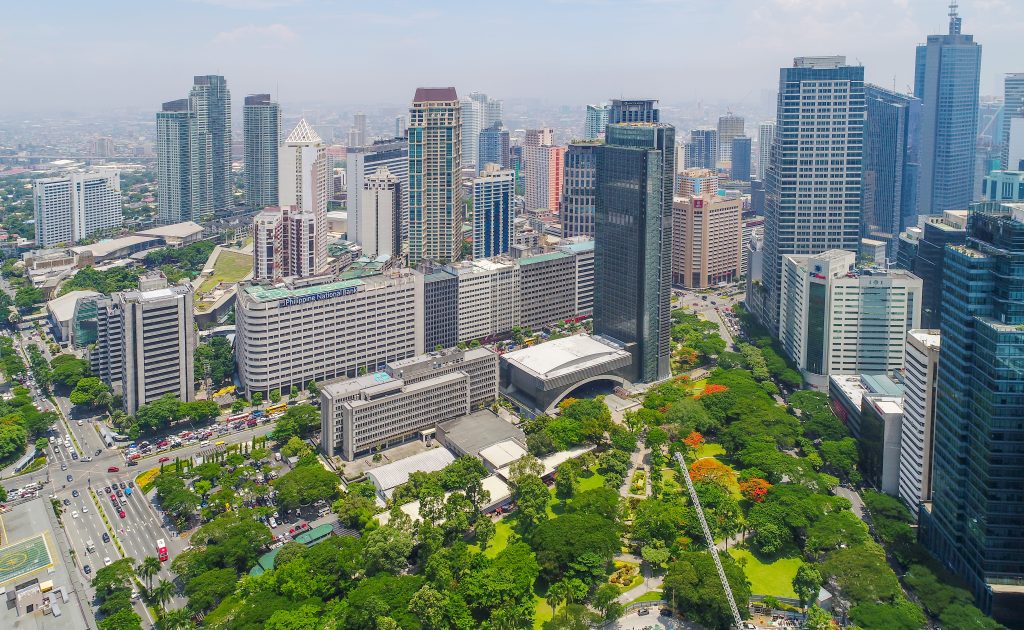


JLL sees resilience amid slower leasing, AI shifts, and the search for the Philippines’ next real estate growth story
Metro Manila’s real estate market entered the second half of 2026 on relatively steady footing, but with enough uncertainty for JLL Philippines to describe the first six months as a “market on watch.”
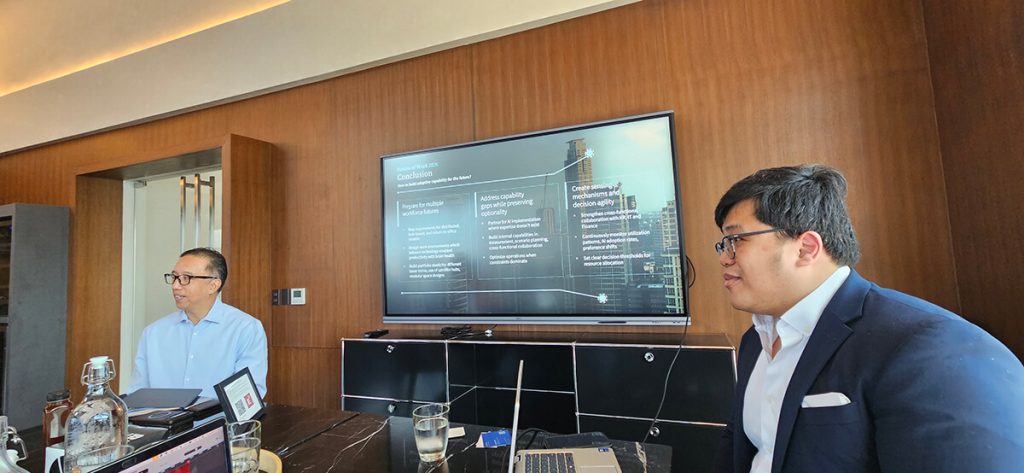
At a recent JLL Philippines media briefing attended by PhilSTAR Property, the real estate services firm presented a market that remains resilient despite softer office leasing and greater caution among corporate occupiers. Artificial intelligence is also beginning to influence how companies think about space, workforce requirements and investment decisions.
“How we describe the first half of this year is ‘market on watch,’ because we saw the real estate sector face a lot of headwinds during the period,” said Janlo de los Reyes, Head of Research and Consultancy at JLL Philippines. “Nonetheless, the sector remained resilient.”
Demand delayed, not gone
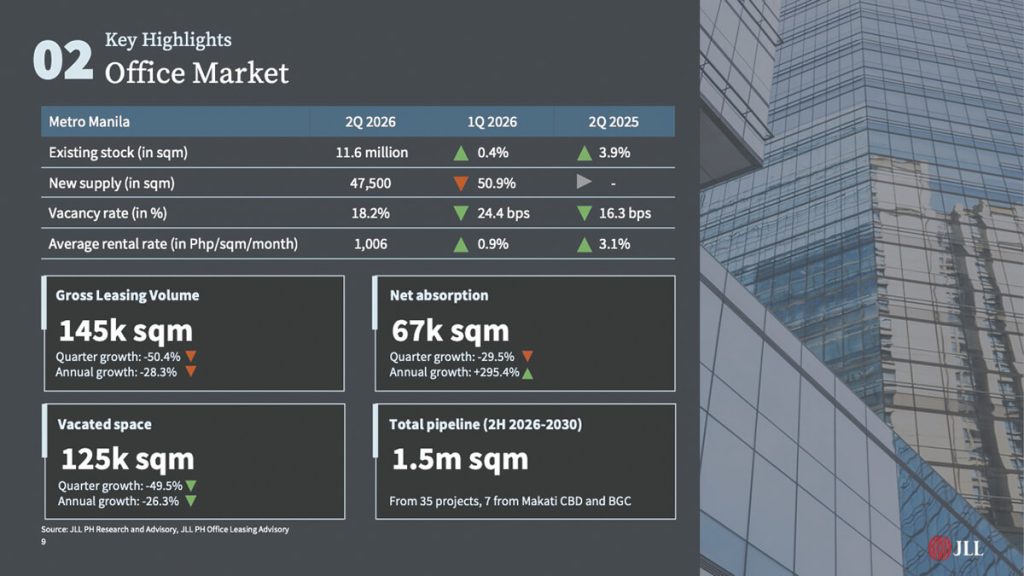
Metro Manila recorded around 436,000 square meters of gross office leasing volume in the first half, down 18.7 percent year-on-year. Second-quarter take-up reached 145,000 square meters, down 50.4 percent quarter-on-quarter. Yet vacancy eased to 18.2 percent, while net absorption remained positive at about 67,000 square meters.
“Though there has been a slowdown in terms of activity, these are mainly deferred deals,” de los Reyes said. “These are delayed deals, not necessarily terminated deals.”
Global Capability Centres (GCCs) and business process outsourcing (BPO) companies continued to anchor the market, accounting for approximately 61 percent of first-half office demand.
For Joey Radovan, JLL Philippines Country Head, that reliance raises a larger question about where the country’s next major source of jobs, investment and property demand will come from.
“Outsourcing has been the story for the last 30 years. It’s still the same story—outsourcing is there, and that’s what AI is going to impact,” Radovan said. “But who’s reporting on the other 50%, 60%—on where jobs are being generated?”
AI changes the workplace equation
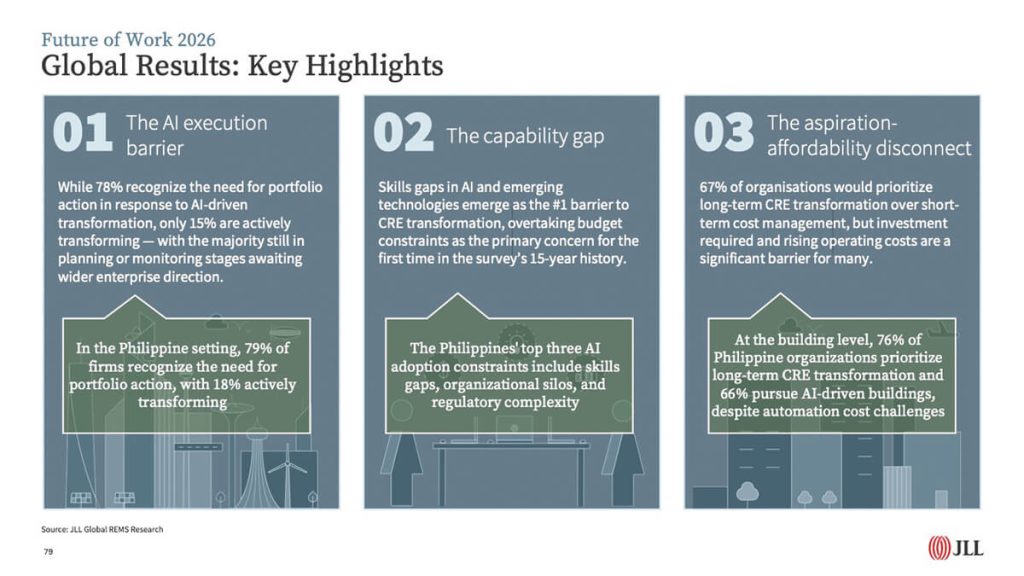
JLL’s 2026 Future of Work Survey found that 79 percent of Philippine organizations recognize the need for portfolio action in response to AI-driven transformation, yet only 18 percent are actively transforming.
“There’s an increasing role of AI in terms of shaping decisions now compared to before,” de los Reyes said. However, “it’s something that a lot of organizations are monitoring closely, but in terms of execution, there’s still a huge gap between monitoring and execution.”
JLL’s findings also point to changing workforce requirements. Three in four Philippine organizations expect headcount growth over the next three to five years, while talent scarcity driven by reskilling requirements remains a key concern.
“There is more talent scarcity, so it’s really more about reskilling our current talent pool as opposed to eliminating or reducing headcount,” de los Reyes said.
Return-to-office expectations are also strengthening, with average required attendance increasing from approximately 3.35 to 4.1 days per week, above the global average of 3.7 days.
“Real estate has become more relevant now compared to before because the question is: It’s not just how big, but what kind of space do we envision for our organization?” de los Reyes said. “It’s no longer a place just to work, but how do we also combine that with the human experience of employees?”
Finding the next growth story
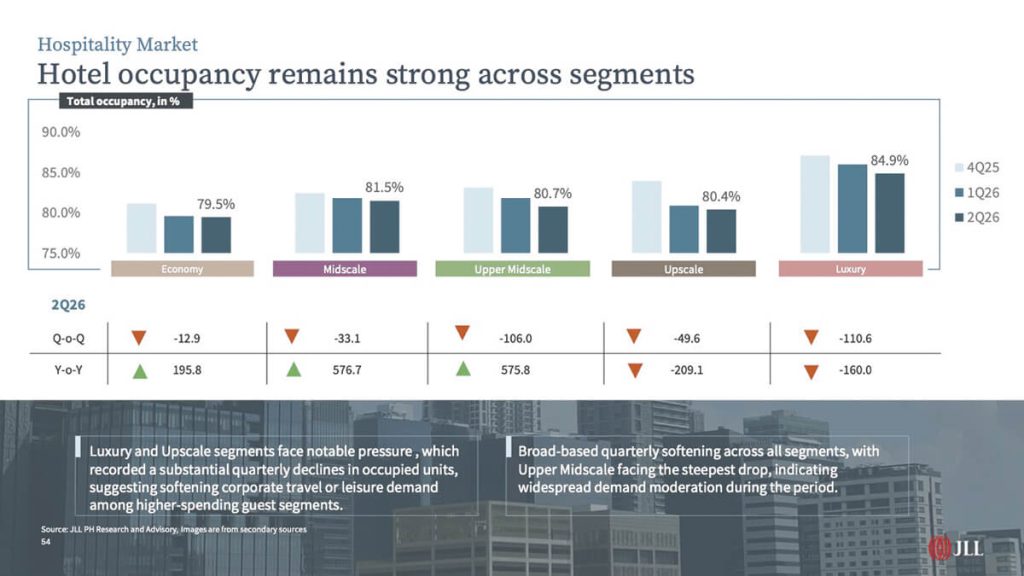
Beyond offices, retail store openings reached approximately 64,000 square meters in the second quarter, up 62.9 percent quarter-on-quarter, while vacancy stood at about 5.6 percent. Hotel occupancy eased to 81.1 percent amid seasonal demand, although JLL maintained that hospitality fundamentals remain strong.
For Radovan, hospitality represents one potential opportunity. “Hospitality—I really believe that is a great opportunity for us,” he said.
But the broader challenge is finding investments capable of generating economic activity and employment at scale.
“What else can we experiment on that investors might resonate with and deploy capital there?” Radovan said. “Because if there’s none, there’s no activity. If there’s no activity, there are no jobs.”
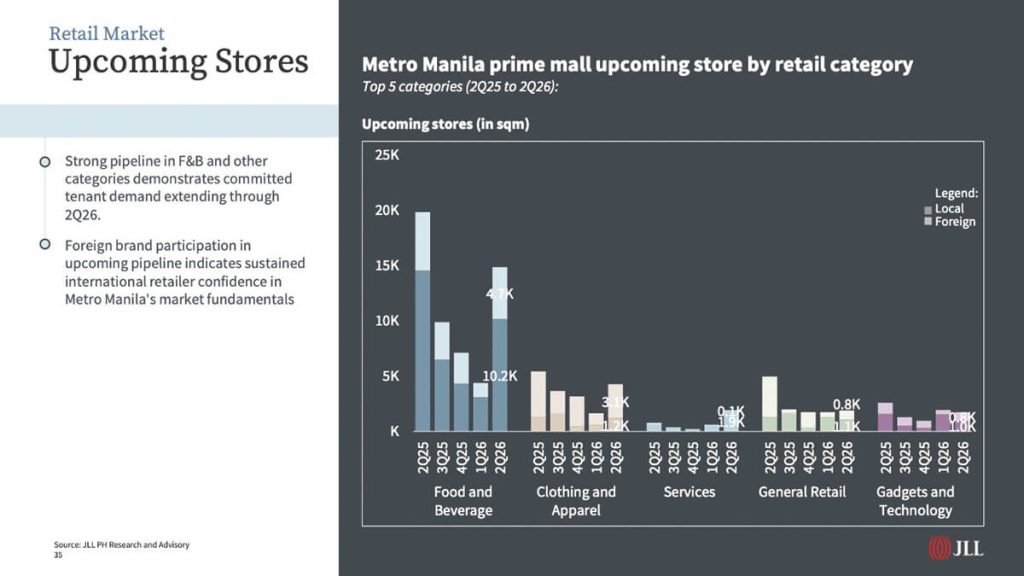
Meanwhile, around 1.5 million square meters of office space across 35 projects is scheduled to enter the market from the second half of 2026 through 2030, alongside approximately 430,000 square meters of retail supply.
As technology, workplace strategies and investment priorities evolve, the question is not simply how the property market performs through the rest of 2026, but where its next sources of demand will come from—and which opportunities can translate investment into sustained economic activity and jobs.
#PhilSTARPropertyFeature
#FeaturedStory